The Chalé Chair: A Conversation with Hallgeir Homstvedt
Lifestyle | Design Dialogues
The Chalé Chair: A Conversation with Hallgeir Homstvedt

February 9, 2026
By: Margarida Sabino, Luis Ferreira and Jason Khoo
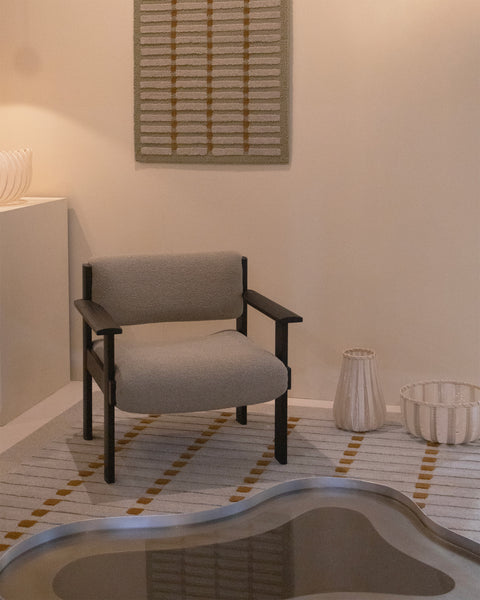
There is something quietly arresting about the Chalé Chair. At first glance, its profile reads as almost box-like, in a simple and two-dimensional profile, with clean lines and geometric precision. But look closer, and you will notice the thick, curvaceous, sweeping backrest and generously cushioned sloping seat, with the structure revealing itself as something more considered and more nuanced than initial impressions suggest. It is this tension between simplicity and complexity that makes Norwegian designer Hallgeir Homstvedt's latest creation for Origin Made so compelling.
We spoke with Hallgeir about the inspiration behind the chair, his design process, and what draws him to continue to work with Origin Made, launching several successful collaborations.
"Norway is a country where very many people have summer or winter cabins, so much so that until the last few decades there was a specific genre of furniture for cabins," Hallgeir explains. "I find this traditional cabin furniture in Scandinavia quite interesting because of its honest construction and robust quality. Traditionally, sofas and armchairs would be constructed from pinewood and upholstered in wool fabric. I wanted to take a similar approach when I set out to design a lounge chair for Origin Made, but in a more refined and elevated manner."
The result is a chair that references vernacular Scandinavian traditions while speaking a decidedly contemporary design language.


Photos by Luis Ferreira
When asked about the moment he knew he had found "the form," Hallgeir's answer reveals his methodical approach, "Although I started with finding an interesting profile, the design itself grew on me when I started working on the construction principle for the chair, which for the Chalé chair is sort of a sandwich, with the structural wood frame placed on either side of the soft seat and back. To me, this assembly not only looks good, but it also makes sense from a tactile and ergonomic perspective."
His process involved extensive model-making: paper studies, 3D-printed prototypes, and eventually full-scale cardboard mock-ups. "When I feel that I am getting close to a finished design, I make 1:1 mock-ups in cardboard and print full-scale drawings," he says. By the time he arrived in Porto to see the initial prototype in wood, the chair was remarkably close to his vision. "It was fun seeing and testing sitting in the chair for the first time. Most of the changes we made were related to the construction and fine-tuning of the ergonomics."
Ask Hallgeir about his favourite detail on the Chalé Chair, and he points to something you might miss at first, "A subtle yet important detail is the wire-brushed finish on the armrests and legs. This creates a tactile experience, inviting touch and allowing one to feel the deeper wood grains, a nod to the craftsmanship involved. Another hidden detail is the concealed hardware, which contributes to the chair's clean and seamless appearance."
It is precisely this attention to the haptic experience, the way a piece of furniture feels with your hands, that distinguishes thoughtful design from one that is run-of-the-mill. The wire-brushed finish directly draws the chair’s user to engage with the material itself, to understand the wood's grain and character.

The Chalé Chair marks Hallgeir's third collaboration with Origin Made, following the Coluna Vases and Teia Textile Collection featuring floor rugs and wall tapestries in various carefully calibrated colour relationships. When asked what makes the partnership work, he is direct, "I think the collaboration is successful because of our shared values in terms of quality, craftsmanship, and aesthetics. I have known Gabriel for close to 15 years now, so he knows my areas of expertise, which helps speed up the ideation phase. Since Origin Made is situated in Porto, they are in close contact with all the suppliers, which again is crucial if you want to have control of the quality of the products and shorten the development phase."
He describes Origin Made as a family-run company that "truly cares about the relationships they have with their suppliers and the designers they work with. I have found that the best products grow from an open dialogue between the producer and the designer, one where both contribute to finding the best solutions."
Looking ahead, Hallgeir expresses curiosity about exploring new techniques with Origin Made. "I don't know if I have a dream product as such, but I am always curious to work with new techniques and learn from skilled craftsmen. I have always wanted to make something out of sand casting or die casting. Glass blowing or casting is also very fascinating."

Outside the studio, Hallgeir maintains a refreshingly grounded perspective. When asked what profession he might have chosen if not design, he mentions his father's influence, "The plan was to become an engineer like my dad, but I switched my degree to industrial design as this felt more immediate and natural for me. That said, I have always liked physical work and nature, so landscaping or landscape architecture would have been interesting."
And his secret skill? "I don't know if this qualifies as a skill, but if the opportunity arises, I can be a fierce Limbo competitor."
Perhaps what is most revealing about Hallgeir’s natural instinct for design is a story he shares about finding inspiration in unexpected places. Early in his career, while working on custom pieces for Elmgreen & Dragset's Venice Biennale exhibition, he became fascinated with mirrors and optical illusions. One night at a local dive bar, he noticed the steel mirrors in the graffiti-covered bathroom, installed so they would not break, and was struck by how sharp the reflection was, where a piece of gum stuck to the mirror doubled perfectly in the reflection. This observation eventually evolved into the "Black Mirror" piece he showed at the 53rd Biennale, a hallway mirror composed of "half self" and "half lamp" that forms perfect circles in reflection.
It is this kind of observational acuity, coupled with technical rigour and an appreciation for honest materials and construction, that makes Hallgeir's work resonate. The Chalé Chair may seem understated, but it grows on you; it invites you to sit, to notice the wire-brushed grain under your fingers, to appreciate the way that comfort and geometry can coexist. As Hallgeir puts it: "The Chalé Chair has a personality that is both modern and timeless. It is inviting and comfortable, yet also refined and elegant. It is a piece of furniture that is meant to be cherished and hopefully passed down through generations."
The Chalé Chair is available in Ash, Smoked Ash, Oak, and Walnut, with upholstery in a choice of leather (Gruppo Mastrotto or Sørensen) or fabric (various options from Mario Sirtori).


Shop the Chalé Chair and other designs by Hallgeir Homstvedt: